For most of the internet era, "search" meant one thing: type a few keywords into a box, scan a page of blue links, and click through until you found an answer. That model held for roughly 25 years. It's now being pulled apart by a new kind of interface — the AI chat window — and the data on how people actually search shows just how far that shift has already gone.
Google still dominates, but its grip has loosened
Google remains the largest search engine on earth, and it isn't close: it still handles the vast majority of desktop searches in the U.S. and processes billions of queries every single day. But the number that matters most to small business owners isn't Google's size — it's the size of its share. Multiple industry trackers that monitor browser and desktop search data have found Google's share of the U.S. desktop search market has slipped from a number that was consistently above 90% for the better part of two decades to somewhere in the high 80s and low 90s over the past two years, with AI tools carving out the difference.
That erosion may sound small in percentage terms, but the trend line is what counts, and it's been moving in one direction since ChatGPT launched in late 2022.
People are opening AI apps first, not just Google
Survey research on search behavior has found that a large share of consumers now say they start a search session by opening an AI chat app rather than a traditional search engine, and separate reporting has put the number of consumers who say they now start searches with AI tools instead of Google in the mid-to-high 30% range. A 2025 national survey on AI usage found that roughly six in ten U.S. adults had used AI to search for information at least once, with that number climbing to about three in four among adults under 30.
Usage of the leading AI assistants backs this up. ChatGPT alone has grown from roughly 400 million weekly active users in early 2025 to figures reported near 800–900 million weekly users in 2026, putting it among the most visited websites in the world and putting it on a growth curve that traditional search never had to contend with.
AI Overviews changed what a Google results page even looks like
Even when people stay on Google, the results page itself has changed. Google's AI-generated summaries — AI Overviews — now appear on a meaningfully larger share of search results than they did even a year ago, with industry benchmarking showing appearance rates roughly doubling year over year. Ahrefs and other SEO research groups have found that when an AI Overview appears above the traditional results, it measurably reduces how often people click through to the websites listed below it. In other words: showing up on page one isn't the finish line it used to be. Increasingly, the AI-written summary is the answer, and the website is optional reading.
Search hasn't shrunk — it's split in two
One nuance that's easy to miss: overall search behavior isn't necessarily declining, it's fragmenting. Research from Semrush found that average weekly Google search sessions actually rose after people adopted ChatGPT, and several analysts tracking combined search-plus-AI usage have found total query volume across both channels has grown by double digits worldwide over the past year. People aren't abandoning Google for AI so much as they're using both, often for different kinds of questions — quick facts and navigation on Google, more open-ended research and recommendations through an AI assistant.
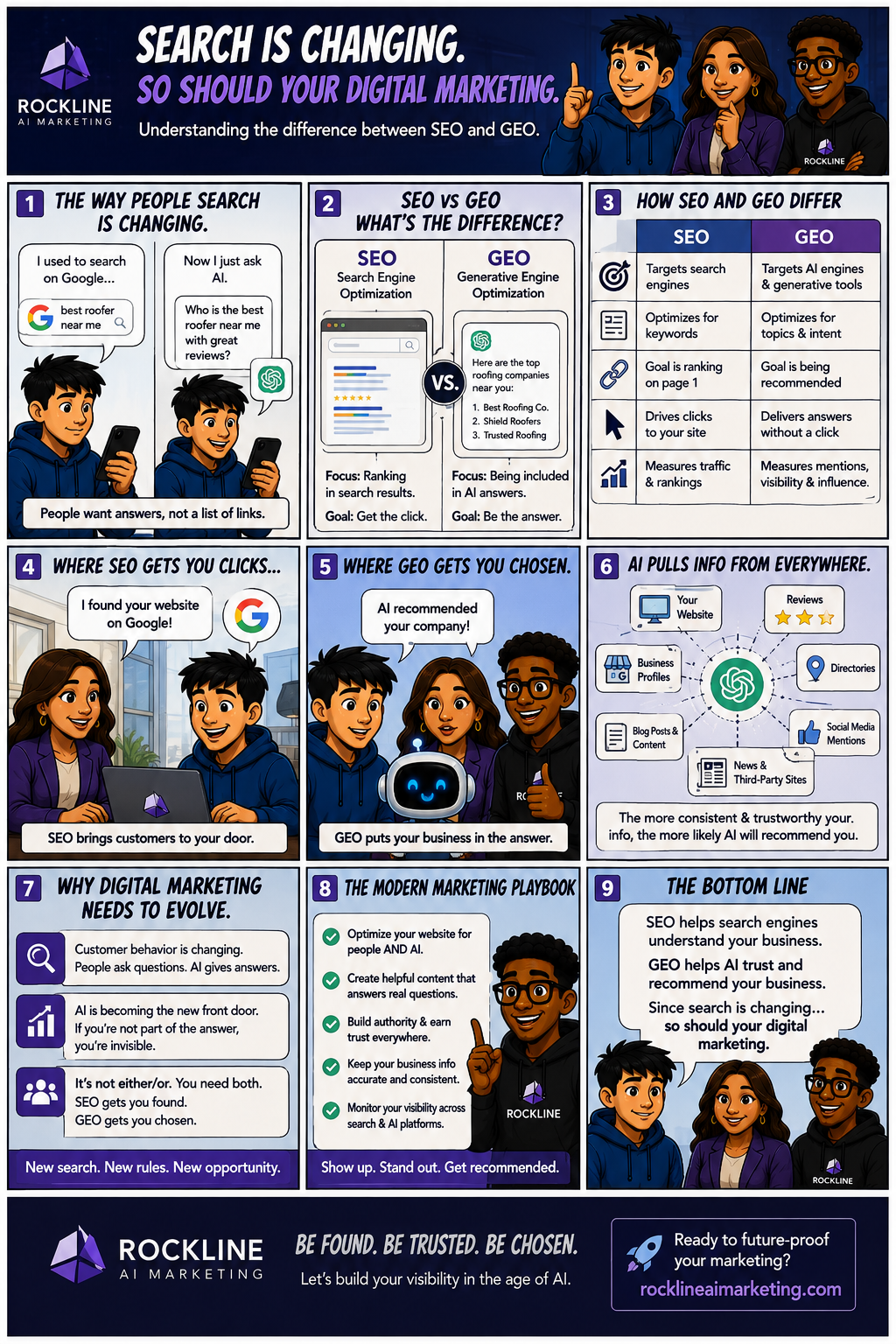
That split matters for a local business. It means the old goal of ranking on page one of Google is no longer the whole job. A business now has to be legible to two very different kinds of "search" at once: the algorithm that ranks links, and the language model that summarizes answers.
What this means in practice
- Two audiences, one presence. Traditional SEO and Generative Engine Optimization aren't competing strategies — they're both drawing from the same underlying digital footprint: your website, your reviews, your listings, and what's said about you elsewhere online.
- Being cited matters as much as being clicked. When an AI system answers a question with your business's name, that's a form of visibility Google rankings never fully captured.
- Clear, direct answers travel further. Whether it's a search engine crawler or a language model pulling context, content that plainly answers a real question tends to perform best in both worlds.
Figures referenced above are drawn from publicly reported industry research, including Search Engine Land, SparkToro/Datos, Semrush, Ahrefs, the AP-NORC Center for Public Affairs Research, and Similarweb, current as of 2026. Search and AI adoption data changes quickly and estimates vary by source and methodology.